
The Hidden Cost of Getting Aluminium Extrusion Wrong
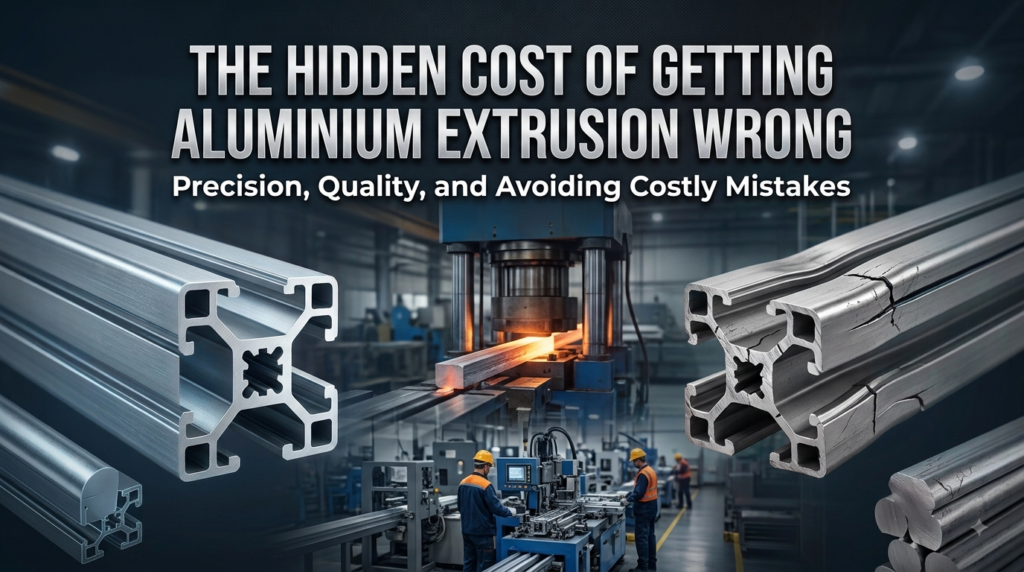
There is a conversation that happens more often than people in manufacturing would like to admit. A project runs behind schedule. A batch of profiles does not fit the assembly. The surface finish is uneven or the dimensions are off by fractions that should not matter but do. Someone has to call the supplier. And somewhere in that conversation, the phrase comes up: “we went with the cheaper option.”
It is an easy decision to make on paper. Aluminium extrusion looks like a commodity. You specify a profile, get a few quotes, and pick the lowest number. But anyone who has been sourcing extruded aluminium for long enough knows that the cost of a wrong decision rarely shows up on the purchase order. It shows up three months later, on the production floor, or worse, after installation.
This is not a scare story. It is a practical look at where things go wrong, what the actual costs are, and why the quality of the manufacturer matters as much as the quality of the alloy.
Dimensional Tolerances: Small Numbers, Big Problems
A profile that is 0.3 mm out of specification might clear incoming inspection. It might even pass the first few assemblies. But in applications where aluminium profiles interface with other components, whether that is a door frame meeting a wall system, a solar mounting rail mating with a clamp, or a heat sink sitting flush against a circuit board, that 0.3 mm gap shows up as a functional failure.
Dimensional accuracy in aluminium extrusion depends on die quality, extrusion speed control, and the ageing process that follows. A manufacturer cutting corners on die maintenance or rushing the cooling and straightening stage will consistently produce profiles that drift from specification. The buyer rarely sees this in a sample. It shows up in production runs.
At KMC Aluminium, tight dimensional control is built into the process from die design to final inspection. With a production capacity of 6,000 metric tonnes and a structured quality management system, consistency is not aspirational, it is measurable.
Alloy Integrity: What You Specify Is Not Always What You Get
The difference between a 6061 and a 6063 aluminium alloy is not just a number. They have different yield strengths, different surface finish responses, and different behaviours under machining and anodizing. Specifying the wrong alloy for an application is one issue. Receiving the wrong alloy when you specified the right one is another problem entirely, and it happens.
Some suppliers blend scrap billets without the chemical consistency needed to guarantee alloy composition. The profiles pass visual inspection. They may even pass basic mechanical checks. But when they go into an anodizing tank, the finish comes out patchy. When they go under load, they fail earlier than modelled. Tracing the problem back to the billet is expensive and time-consuming.
This is where working with a manufacturer that controls its billet sourcing and tests incoming material makes a real difference. Knowing the alloy temper designation is one thing. Knowing the billet it came from was consistent is another.
Surface Finishing Failures Are Rarely About the Finish
Powder coating or anodizing that fails in the field almost always has its roots in the extrusion stage, not the finishing stage. Surface defects, die lines, or inconsistent metal flow during extrusion create micro-level irregularities that the coating cannot bridge. A powder coat over a poorly extruded surface will peel. An anodic layer over an inconsistent base will pit or colour unevenly.
Architects and contractors who specify anodized aluminium window systems for coastal or high-humidity environments find this out the hard way. The profiles look fine at delivery. Six months in, they see streaking or early surface breakdown. By then, the project is handed over and the dispute is complicated.
The value added services at KMC Aluminium are structured precisely to avoid this. Anodizing and powder coating are applied to profiles that have been extruded, aged, and inspected under the same roof. The surface quality of the extrusion is the foundation. The finish is the outcome.
Lead Time Promises and What They Actually Mean
A supplier who quotes a four-week lead time on a custom profile should be able to explain exactly how that number was calculated. In reality, lead time promises in the aluminium extrusion industry are sometimes aspirational. Die fabrication, billet availability, press scheduling, and finishing queues all affect when material actually ships.
For a construction project or a manufacturing line running on a tight schedule, a two-week delay in profile delivery can cascade into penalties, idle labour, and rescheduling across the supply chain. The cost of that delay is orders of magnitude larger than whatever was saved on the unit price.
When evaluating a supplier, it is worth asking how they manage their press schedule, whether they carry billet inventory, and what their track record on custom die delivery looks like. These questions tell you more about reliability than a price sheet ever will.
The Cost That Does Not Show on the Invoice
Rework, scrap, project delays, and warranty claims all have something in common: none of them appear on the original purchase order. They show up later, absorbed into overhead, charged to a project budget, or written off as a lesson. The calculation that makes a cheaper supplier look attractive rarely factors these in.
This is not an argument for always buying the most expensive option. It is an argument for buying from manufacturers who can demonstrate process control, quality documentation, and the kind of production infrastructure that makes consistency repeatable rather than occasional.
India’s aluminium extrusion industry has grown significantly over the past decade, and with that growth has come a wide range in manufacturing standards. Buyers who understand what to look for, die quality, billet control, press technology, ageing furnaces, and in-house surface treatment, are in a much better position to make decisions that hold up over time.
Getting aluminium extrusion right is not complicated, but it does require sourcing from a manufacturer who treats it seriously. KMC Aluminium has spent nearly two decades building the process discipline, production capacity, and technical capability to back up every profile that leaves the facility. The goal has never been to be the cheapest option. It has been to be the one you do not have to worry about. That, in the long run, is the better value.

Recent Comments