
Choosing the Right Alloy: A Practical Guide to Aluminium Extrusion for Indian Buyers
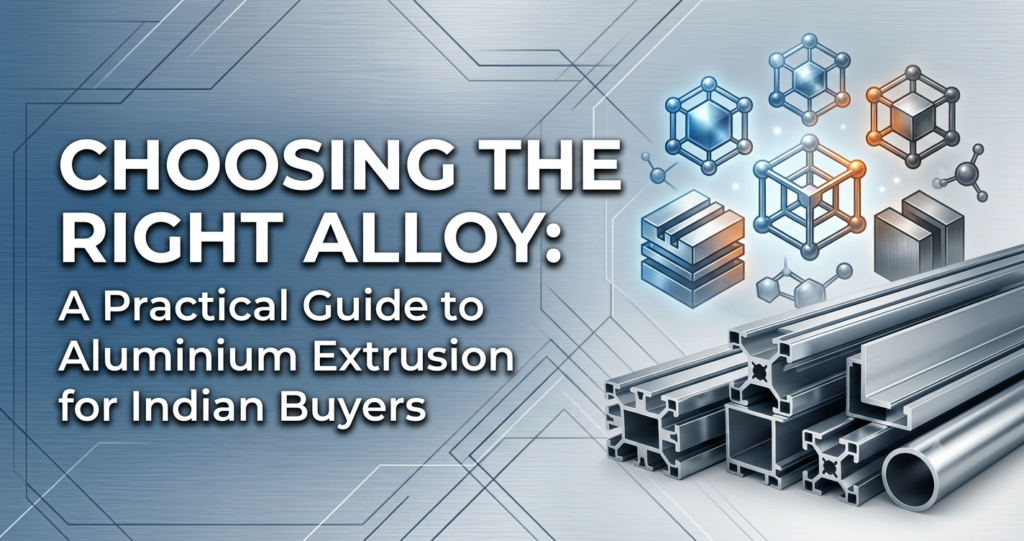
Most project delays do not start on site. They start at the specification stage, when a drawing calls for a profile without naming the alloy or temper it should be made from. The result is a section that sags under load, refuses to anodise evenly, or costs far more than it needed to.
Alloy selection is where good aluminium extrusion begins. As one of the established aluminium extrusion manufacturers in India, we are asked the same question every week: which grade should we specify? Here is how to answer it.
Why alloy choice decides the outcome
Aluminium is not a single material. It is a family of alloys, each tuned by small additions of magnesium, silicon, manganese and copper. Those additions change strength, corrosion resistance, weldability, surface finish and — critically — how easily the metal flows through a die. A grade that extrudes beautifully into a thin architectural section may be the wrong choice for a load-bearing bracket.
For extruded work, the 6000 series does most of the heavy lifting. Three grades cover the overwhelming majority of Indian projects.
6063 — the architectural workhorse
If you are specifying window frames, curtain wall sections, louvres, partitions or handrails, 6063 is almost always the answer. It has moderate strength but exceptional surface quality, which is why aluminium profile manufacturers reach for it whenever anodising or powder coating is involved. It extrudes into complex, thin-walled shapes with crisp corners and holds a finish for decades in humid coastal conditions — a real consideration along the Tamil Nadu and Kerala coastline.
6061 — when strength matters more than finish
6061 carries roughly twice the yield strength of 6063 and welds well, making it the standard choice for structural members, machine frames, transport components and mounting systems. The trade-off is cosmetic: it does not anodise to the same uniform clarity, and it resists flow, so intricate sections cost more to run. Specify 6061 where the part must carry load, not where it must be looked at.
6082 — the heavy-duty option
Higher in manganese, 6082 offers the best strength of the three and excellent machinability. It appears in bridge sections, cranes and solar mounting structures, and increasingly in aluminium in electric vehicle battery enclosures, where crash performance and thermal management both matter. Many aluminium products manufacturers now default to 6082 for renewable energy hardware, where structures must survive twenty years of wind loading with minimal maintenance.
Temper is half the specification
Naming the alloy without the temper is an incomplete instruction. T5 profiles are quenched at the press and artificially aged — economical, dimensionally stable, ideal for architectural sections. T6 profiles undergo full solution heat treatment before ageing, delivering higher strength but at greater cost and with slightly more distortion risk. A 6063-T6 section can outperform a 6061-T5 one, which surprises buyers who assume the alloy number tells the whole story.
The process shapes what is possible
The aluminium extrusion process imposes real limits. Wall thickness ratios, hollow versus semi-hollow geometry, circumscribing circle diameter and tongue ratio all determine whether a section can be run at all, and at what tolerance. Involving your extruder at the drawing stage — rather than after tooling is cut — routinely saves weeks and lakhs. Good aluminium extrusion profiles manufacturers will redraw a section to improve die life without changing its function.
What to ask before you shortlist a supplier
When you compile a list of aluminium extrusion companies in India, look past price per kilogram:
- Press capacity and billet range — can they run your circumscribing circle?
- In-house die design — outsourced tooling means slower corrections.
- Ageing oven and quench control — this is where temper consistency is won or lost.
- Finishing under one roof — anodising, powder coating, mill finish.
- Value-added work — CNC machining, fabrication, assembly.
The strongest aluminium profile suppliers answer all five without hesitation. Those that cannot are usually trading, not manufacturing.
Specification support from KMC
KMC Aluminium is among the largest names in aluminium manufacturing in Tamil Nadu, with a 6,000 metric tonne capacity and a client base spanning construction, automotive, solar and industrial equipment. Our aluminium manufacturing in Chennai operation combines in-house die design, controlled ageing and a full finishing line, so alloy, temper and surface specification are handled as one decision rather than three.
That integration is why buyers searching for the best aluminium company in Chennai tend to shortlist an aluminium extrusion company that owns its own finishing line rather than subcontracting it. We work with architects and design engineers before tooling is committed, reviewing sections for extrudability, tolerance and finish. It is the least glamorous stage of any project — and the one that determines whether it runs to schedule.
Planning a project? Send us your drawings and we will advise on alloy, temper and section design. Explore our aluminium extrusion abilities, review our value-added services or contact our team directly.

Recent Comments