
From Billet to Building: Why Aluminium Profiles Are the Quiet Force Behind Modern Infrastructure
Walk through any modern building, step into a new metro station, look up at a solar installation, or glance at the sleek frame of an electric vehicle — and you will find aluminium profiles holding it all together. Silent, structural, and indispensable. Yet despite being one of the most widely used materials in construction and manufacturing today, aluminium profiles rarely get the recognition they deserve. At KMC Aluminium, Tamil Nadu’s largest aluminium extrusion manufacturer, we believe it is time to change that.
What Exactly Is an Aluminium Profile?
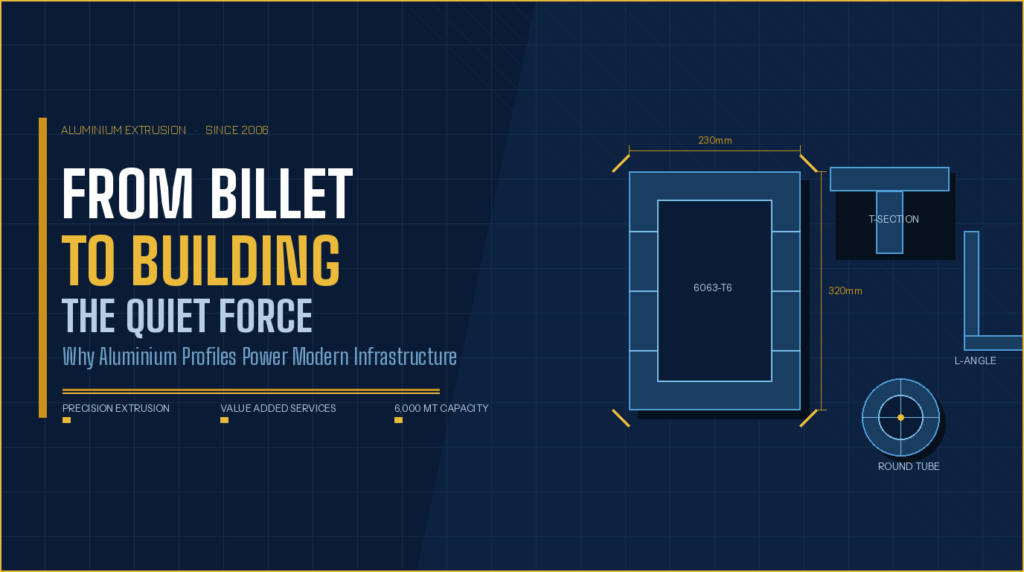
An aluminium profile is a precisely shaped length of aluminium alloy produced through the aluminium extrusion process — where a heated billet is forced through a custom-designed die to create a specific cross-sectional shape. The result can be a simple flat bar, a complex hollow section, or an intricate multi-chambered profile engineered to exact load-bearing, thermal, or aesthetic specifications. The flexibility of this manufacturing process is unmatched. It is why aluminium profiles are found in everything from curtain wall systems and window frames to industrial conveyor structures and LED lighting channels.
Lightweight Strength That Outperforms
One of the defining properties of aluminium is its exceptional strength-to-weight ratio. Aluminium weighs roughly one-third of steel, yet when alloyed and extruded correctly, it delivers structural performance that meets or exceeds many engineering requirements. This is critical in sectors like aerospace, automotive, and green construction, where reducing dead load directly translates to better performance, lower energy consumption, and reduced material costs. The 6000-series aluminium alloys — particularly 6061 and 6063 — are among the most popular choices for extruded profiles globally, prized for their balance of strength, corrosion resistance, and surface finish quality.
Corrosion Resistance: Built for the Long Term
Unlike steel, aluminium does not rust. When exposed to air, it naturally forms a thin, stable oxide layer that acts as a self-repairing barrier against moisture, salt, and environmental degradation. This innate corrosion resistance makes aluminium profiles particularly valuable in coastal construction, marine infrastructure, and outdoor architectural applications — environments where steel would require constant maintenance or protective coating just to survive. For building owners and project managers, this translates directly into lower lifecycle costs and longer asset durability.
The Role of Surface Finishing in Profile Performance
A raw aluminium extrusion is only the beginning. The true performance of a profile is often determined by the surface treatment it receives. At KMC Aluminium, our value added services include anodizing and powder coating — two of the most widely specified finishes in the industry. Anodizing electrochemically thickens the natural oxide layer, dramatically improving hardness, abrasion resistance, and aesthetic consistency. Powder coating offers an extensive palette of colours and textures, making it the preferred choice for architectural aluminium in doors, windows, facades, and railings. Both finishes extend the service life of profiles significantly and reduce maintenance requirements over time.
Aluminium Profiles in India’s Growth Sectors
India’s infrastructure boom is creating unprecedented demand for high-quality aluminium profiles. In the renewable energy sector, extruded aluminium is the structural backbone of solar panel mounting systems — lightweight enough to simplify installation on rooftops and ground-mounted arrays, yet strong enough to withstand decades of wind, rain, and thermal cycling. In the electric vehicle industry, aluminium profiles are increasingly specified for battery enclosure frames, structural crash members, and lightweight body components. In smart city construction, they form the framework of modern facades, automatic doors, and modular interior systems. Each of these applications demands precision — in alloy selection, dimensional accuracy, and surface quality.
Precision Manufacturing: Where Quality Is Non-Negotiable
Not all aluminium extrusions are created equal. The quality of a profile is a direct reflection of the manufacturing process behind it — the consistency of the billet, the precision of the die, the control of extrusion speed and temperature, and the rigour of post-extrusion quality checks. At KMC Aluminium, our quality management system governs every stage of production. With a capacity of 6,000 metric tonnes and a product range spanning standard commercial profiles to custom-engineered solutions, we supply industries across India with extruded aluminium that meets the highest dimensional and mechanical standards. Consistency is not a target — it is the baseline.
Sustainability: The Case for Aluminium in a Net-Zero World
As industries globally align with net-zero targets, the material choices made today will define the environmental outcomes of tomorrow. Aluminium is one of the few structural materials that is infinitely recyclable without any loss of performance. Recycling aluminium consumes just a fraction of the energy required for primary production, making it a cornerstone of sustainable manufacturing and circular economy strategies. Specifying aluminium profiles in construction and industrial applications is not just a performance decision — it is an environmental one.
Aluminium profiles are not just components — they are the structural language of modern engineering. From the first die impression to the final anodized finish, every profile that leaves a KMC Aluminium facility carries with it decades of manufacturing expertise, a commitment to precision, and a belief that quality built into the material is quality built into the world. When you choose KMC Aluminium, you are not just sourcing a product. You are partnering with Tamil Nadu’s most trusted name in aluminium extrusion — built to last, engineered to perform.

Recent Comments