
How to Design a Custom Aluminium Extrusion Profile- 7 Rules That Cut Die Cost and Lead Time
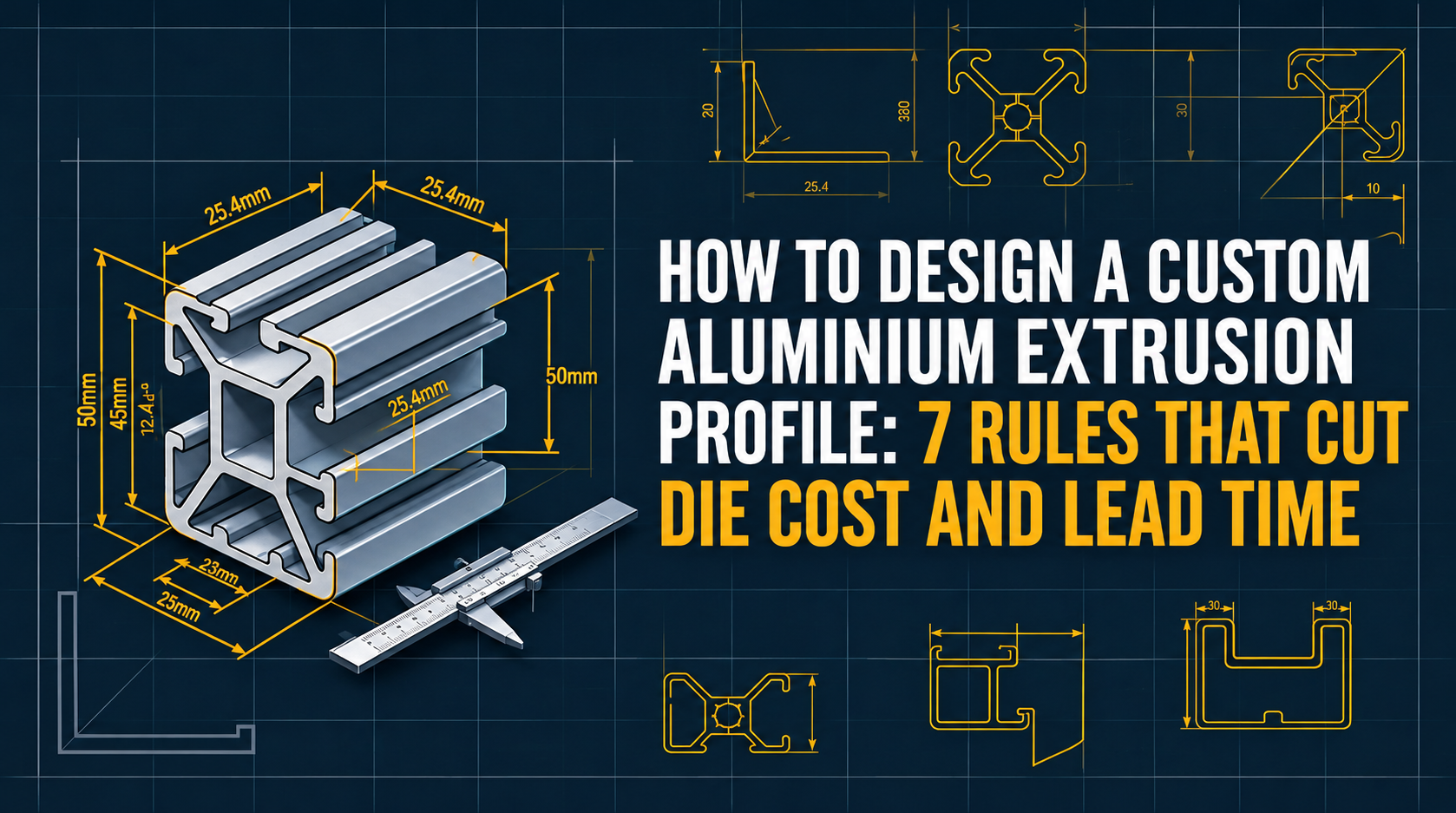 A good custom aluminium extrusion design fits inside the press’s circle size, keeps walls even, uses rounded corners, avoids deep narrow channels, chooses solid shapes over hollows where possible, puts tight tolerances only on critical dimensions, and specifies the alloy and finish up front. These design for manufacturability (DFM) rules lower die cost, reduce rejections and shorten aluminium extrusion lead time.
Most delays in custom aluminium profiles projects start at the drawing board, not the press. A profile that looks simple in CAD can be hard to extrude, leading to die corrections, scrap and missed dates. Good aluminium extrusion profile design avoids this. Here are seven rules our tool room uses when reviewing customer drawings.
7 DFM rules for aluminium extrusion profile design
1. Fit the circumscribing circle diameter (CCD)
The circumscribing circle diameter is the smallest circle that fully contains your profile’s cross-section. Every press has a maximum CCD, and larger circles need bigger presses and costlier dies. Share your overall dimensions early so the extruder can confirm press fit, or suggest splitting a wide part into two interlocking profiles.
2. Keep aluminium extrusion wall thickness uniform
Metal flows fastest through thick sections and slowest through thin ones. Large swings in wall thickness cause uneven flow, distortion and surface streaks. Aim for walls that are as even as possible, and keep the thickest-to-thinnest ratio low. If one area must be heavier, taper into it gradually rather than stepping.
3. Round every corner
Sharp internal and external corners concentrate stress in the die and on the part. A small radius, often 0.5 to 1 mm, improves metal flow, extends die life and gives a cleaner anodized or powder-coated edge. Mark the few corners that truly must stay sharp.
4. Avoid deep, narrow channels
A slot that is much deeper than it is wide creates a long, thin “tongue” in the die. That tongue can bend or break under extrusion pressure. Keep channel depth close to its width where you can, widen the opening, or add a radius at the root to strengthen the die.
5. Choose solid shapes before hollows
In aluminium extrusion die design, solid and semi-hollow shapes use simpler flat dies. Hollow aluminium profiles need porthole or bridge dies, which cost more and take longer to make and correct. Hollows are worth it for stiffness, tubing and cooling channels, but ask whether an open shape with a snap-fit or screw boss could do the same job. This one decision often has the largest effect on aluminium extrusion die cost.
6. Apply aluminium extrusion tolerances only where they matter
Standard commercial tolerances, such as those in EN 755-9, suit most features. Tighter limits need slower runs, extra checks and sometimes machining. Mark only the dimensions that affect fit or function as critical, and let the rest follow the standard. Your price and lead time will both improve.
7. Specify alloy, temper and finish at the start
The 6063 aluminium alloy extrudes easily and gives the most uniform finish, which makes it the usual choice for anodized aluminium profiles, windows and heat sinks. 6061 and 6082 are stronger but are harder to push through complex dies. Note which faces are visible so the extruder can protect them during handling and plan die-line placement.
How design choices affect die cost and lead time
|
Design choice |
Lower cost and faster |
Higher cost and slower |
|
Shape type |
Solid or semi-hollow |
Multi-cavity hollow |
|
Wall thickness |
Uniform |
Large thick-thin swings |
|
Corners |
Radiused |
Sharp |
|
Tolerances |
Standard on most features |
Tight on every dimension |
|
Alloy |
6063 |
6061 or 6082 in complex shapes |
Why your extruder should review the drawing
As an aluminium extrusion manufacturer in Chennai, KMC Aluminium reviews every new drawing in its in-house tool room before a die is cut. We run three extrusion presses using 100% homogenized billets, and we are certified to IATF 16949:2016 and ARAI AIS:140. Our value-added services, including cutting, drilling, slotting, tapping and chamfering, mean your custom aluminium profiles arrive ready to assemble.
Among aluminium extrusion suppliers in India, we focus on getting the design right first, because a corrected die costs more than a well-planned one. Send us your drawing or a rough sketch and we will suggest DFM changes before you commit.
Send KMC Aluminium your drawing for a profile design review
FAQs
What is the minimum wall thickness for an aluminium extrusion?
It depends on the alloy, the profile size and the press. Small 6063 profiles can often go to around 1 mm, while larger or stronger-alloy shapes need thicker walls. Ask your extruder to confirm for your design.
How much does an aluminium extrusion die cost?
Die cost depends on profile size, complexity and whether it is solid or hollow. Solid dies cost less; hollow porthole dies cost more. Share your drawing for an exact quote.
How long does a custom aluminium extrusion take?
Die making and first trials usually take a few weeks, followed by production. Clear drawings with standard tolerances shorten the process.
Which alloy is best for custom aluminium profiles?
6063 suits most architectural, decorative and heat sink profiles. Choose 6061 or 6082 when the part carries structural loads.

Recent Comments