
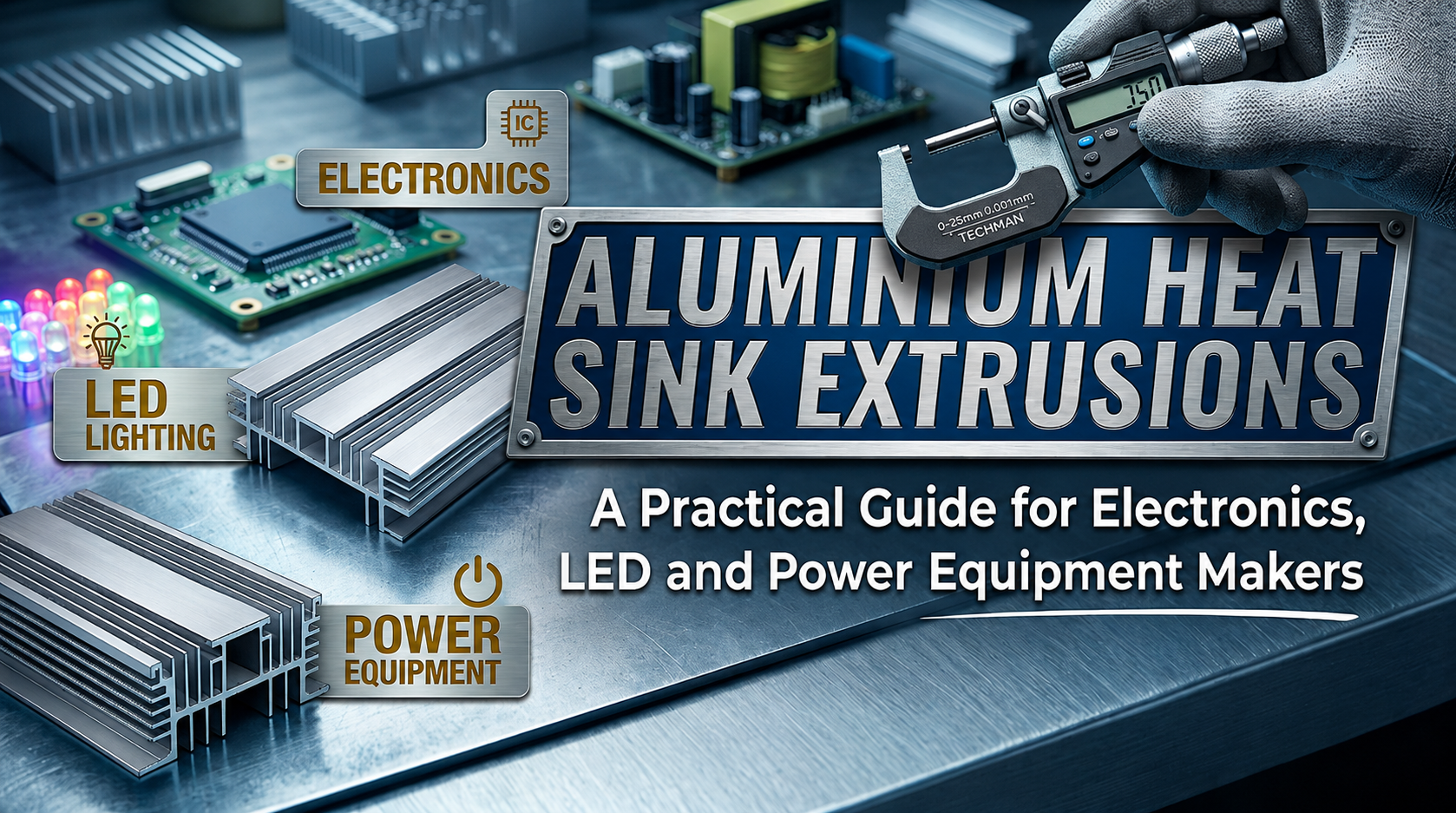
 Aluminium Heat Sink Extrusions: A Practical Guide for Electronics, LED and Power Equipment Makers
An aluminium heat sink extrusion is a finned aluminium profile that pulls heat away from electronic components and releases it into the surrounding air. For medium- to high-volume production, extrusion is one of the most cost-effective ways to manufacture heat sinks, especially when the design needs long, consistent profiles with complex fin geometry. 6063 aluminium is the industry’s preferred alloy because it offers strong thermal conductivity and excellent extrudability for thin, closely spaced fins.cooltec+1
Every LED driver, solar inverter, motor controller and EV charger converts part of its input power into heat. If that heat is not managed effectively, components lose efficiency, age faster and can fail prematurely. A common engineering rule of thumb is that the life of many electronic components roughly halves for every 10 °C rise in operating temperature—making thermal management a core design requirement, not an afterthought.
How an extruded heat sink works
Heat moves from the hot component into the heat sink base, spreads through the aluminium body, and then dissipates through the fins. The fins increase the surface area exposed to air, allowing heat to leave mainly through convection—natural airflow or fan-driven airflow—along with some radiation.
In extrusion, a heated aluminium billet is pushed through a precision steel die shaped like the required fin profile. The resulting long section is cut to length and machined as needed. Because the base and fins are formed from one continuous piece of metal, there is no joint or interface to restrict heat flow.
Why aluminium is preferred
Copper conducts heat better than aluminium, but it is roughly three times heavier and considerably more expensive. For most electronics, LED and power-equipment applications, aluminium offers the best balance of performance, weight, cost and manufacturability.
Fin design rules engineers should know
A good heat sink does not simply maximise fin area. It balances surface area, airflow, material use and manufacturability.
-
Fin aspect ratio: This is fin height divided by the gap between fins. Standard extrusion dies commonly handle ratios up to around 10:1; higher ratios may require specialised tooling, so define targets early.
-
Fin spacing: Natural convection needs wider gaps so warm air can rise freely. Fan-cooled designs can use tighter spacing to increase surface area.
-
Base thickness: A thicker base helps spread heat from a small hot spot across the full fin area.
-
Fin orientation: For fanless applications, orient fins vertically to support natural airflow.
-
Surface flatness: A flat mounting surface improves thermal contact with the component. Specify machining when flatness tolerances are critical.
Does black anodizing help?
Black anodizing is more than a cosmetic finish. Anodizing creates a hard oxide layer that improves corrosion resistance and electrically insulates the surface. Black anodizing also increases emissivity, helping the heat sink radiate heat more effectively.
The benefit is most noticeable in fanless designs such as LED street lights, high-bay fixtures and enclosed power equipment. In fan-cooled systems, where convection dominates, clear anodizing is often sufficient.
Key applications
Aluminium heat sink extrusions are used wherever power electronics generate concentrated heat:
-
LED lighting: Street lights, high-bay lights, floodlights and linear fixtures.
-
Solar and energy storage: Solar inverters, UPS systems and battery energy storage systems.
-
Industrial power electronics: Motor drives, welding equipment, controllers and power supplies.
-
EV and mobility: EV chargers, on-board chargers, converters and motor controllers.
-
Telecom and audio: Telecom cabinets, amplifiers and other heat-generating electronic enclosures.
As India expands domestic manufacturing of electronics, LED lighting and renewable-energy equipment, demand for locally produced custom heat sink profiles continues to rise. Working with a nearby extruder can also shorten lead times and accelerate design iterations.
Choosing a heat sink profile manufacturer
Not every aluminium extruder can consistently produce fine-fin heat sink profiles. When evaluating a manufacturer, look for:
-
In-house die design experience with multi-fin and high-aspect-ratio sections.
-
Consistent billet quality, which directly affects thermal performance.
-
Precision cutting, drilling, tapping and machining for ready-to-assemble profiles.
-
Tight control of fin thickness, fin spacing and base flatness.
-
Capability to support custom profiles, finishes and volume production.
Partner with KMC Aluminium
KMC Aluminium is an established aluminium extrusion company in Chennai, manufacturing heat sink profiles for LED lighting, power electronics, industrial equipment and other demanding applications. The company extrudes quality billets sourced from Vedanta across three presses and is supported by an in-house tool shop experienced in intricate, multi-fin die designs.
KMC also offers in-house cutting, drilling, slotting, chamfering and tapping, allowing heat sink profiles to arrive ready for assembly. For LED, solar, EV and industrial electronics manufacturers seeking a reliable custom heat sink manufacturer in India, KMC Aluminium combines extrusion capability, precision finishing and application-focused engineering support.
Share your drawing or thermal requirements with KMC Aluminium to discuss alloy selection, fin geometry, surface finish and production volumes. Learn more at kmcaluminium.com.
FAQ
What is the best aluminium alloy for heat sinks?
6063 is generally the best choice because it combines high thermal conductivity with excellent extrudability for thin fins.cooltec+1
Is an extruded heat sink better than a die-cast one?
For thermal performance, usually yes. Wrought 6063 conducts heat better than typical die-casting alloys, and extrusion tooling is usually more economical. Die casting is better suited to complex 3D shapes produced in very high volumes.
Does black anodizing improve heat sink performance?
Yes, particularly in natural-convection designs. A black anodized surface radiates heat more effectively than bare aluminium, while also improving corrosion resistance and electrical insulation.

Recent Comments