
6063 vs 6061 vs 6082 Aluminium Alloy: Which Extrusion Alloy Is Right for Your Project?
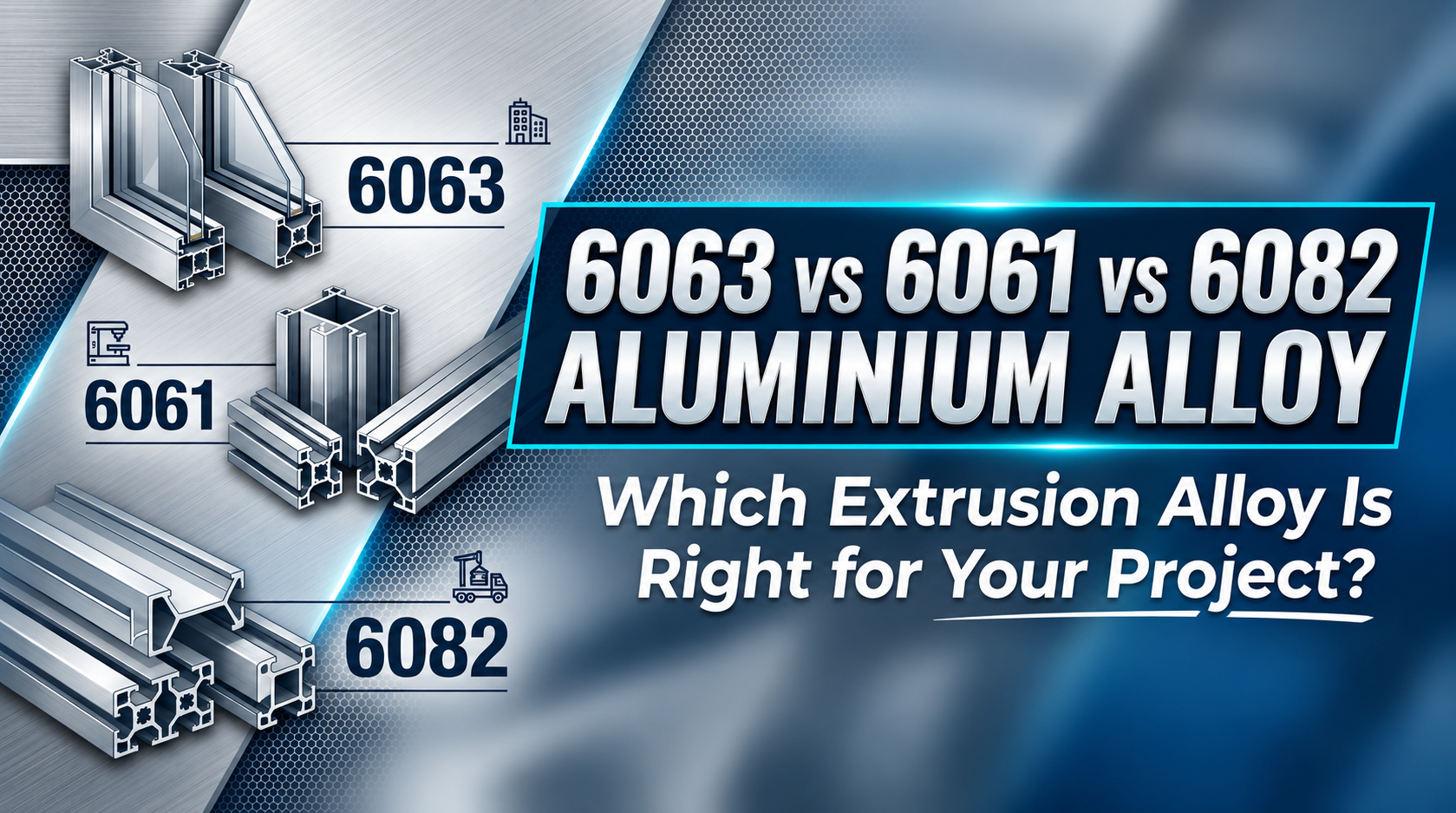 Choose 6063 aluminium alloy when surface finish, anodizing quality and complex shapes matter most, such as windows, doors, façades and heat sinks. Choose 6061 or 6082 when the part must carry structural load. 6082 is the more common structural grade in India and Europe, while 6061 is widely specified in American drawings and machined parts.
A profile that looks perfect but bends under load, or a strong section with a patchy anodized finish, usually traces back to one decision: alloy selection. This guide explains how the three most-used aluminium extrusion alloys differ, so engineers, architects and purchase teams can specify with confidence.
What do 6063, 6061 and 6082 have in common?
All three belong to the 6xxx series, alloyed mainly with magnesium and silicon. Together these form magnesium silicide, which lets the metal be strengthened by heat treatment. All three offer good corrosion resistance, weldability and recyclability. Small differences in chemistry, mainly added copper or manganese, change strength, extrudability and finish significantly.
6063 aluminium alloy: the architectural workhorse
6063, known in Indian standards as HE9 (63400), has the leanest alloy content of the three. It flows easily through a die, so extruders can produce thin walls, sharp corners and intricate hollow sections quickly and economically.
Typical 6063 T6 properties are about 240 MPa tensile strength and 210 MPa yield strength. In T5 temper, these drop to roughly 185 MPa and 145 MPa.
Where 6063 wins is appearance. It gives the smoothest surface and the most uniform results when anodizing aluminium profiles or powder coating them. It also has the highest thermal conductivity of the three, close to 200 W/m·K.
Best for: architectural aluminium profiles, sliding windows, doors, curtain walls, railings, furniture, LED housings and heat sinks.
6061 aluminium alloy: the precision all-rounder
6061, Indian equivalent HE20 (65032), adds small amounts of copper and chromium. In T6 temper it typically reaches about 310 MPa tensile and 275 MPa yield strength. It machines cleanly and holds tight tolerances.
The trade-off is extrudability. Very thin or complex sections become difficult and costlier, and its anodized finish is less uniform than 6063.
Best for: CNC-machined components, jigs and fixtures, marine hardware, automotive parts and designs based on US specifications.
6082 aluminium alloy: the structural specialist
6082, Indian equivalent HE30 (64430), contains manganese, which refines grain structure and lifts strength to around 300–310 MPa tensile in T6, with excellent corrosion resistance. It is the go-to grade for structural aluminium extrusions in India and Europe. Like 6061, it needs slightly thicker walls and simpler geometry.
Best for: load-bearing frames, scaffolding, trusses, rail components, truck bodies and solar mounting structures.
Comparison Chart
|
Property |
6063 (HE9) |
6061 (HE20) |
6082 (HE30) |
|
Typical tensile strength, T6 |
~240 MPa |
~310 MPa |
~300–310 MPa |
|
Typical yield strength, T6 |
~210 MPa |
~275 MPa |
~255–260 MPa |
|
Extrudability |
Excellent |
Fair |
Fair |
|
Anodizing finish |
Excellent |
Good |
Good |
|
Machinability |
Fair |
Very good |
Very good |
|
Thermal conductivity |
Highest |
Medium |
Medium |
|
Relative cost to extrude |
Lowest |
Higher |
Higher |
Typical values for guidance only. Always confirm against the applicable IS or EN standard and your supplier’s test certificate.
T5 vs T6 temper: what does the letter mean?
Temper describes how the alloy was heat treated, and it affects strength as much as the alloy itself.
- T5: cooled straight from the extrusion press, then artificially aged. Economical and ideal for most 6063 architectural sections.
- T6: solution heat treated, quenched and artificially aged for maximum strength.
When weighing T5 vs T6 temper, ask what the profile must do. A window frame rarely needs T6; a structural member almost always does. Controlled ageing matters either way. At KMC Aluminium, profiles are aged at around 190–195 °C for about 3.5 hours, followed by forced-air cooling, for consistent mechanical properties.
A simple aluminium alloy selection guide
Use this three-question aluminium alloy selection guide before sending a drawing for quotation:
- Is the part visible or decorative? Start with 6063.
- Does it carry significant structural load? Move to 6082, or 6061 if your design standard requires it.
- Will it be heavily machined? 6061 or 6082 will cut cleaner.
If answers conflict, an experienced extruder can often redesign a 6063 section with smarter wall thickness instead of switching to a harder alloy.
Why the extruder matters as much as the alloy
The same alloy performs differently depending on billet quality, die design and process control. As an established aluminium extrusion manufacturer in Chennai, KMC Aluminium uses quality billets sourced from Vedanta, runs three extrusion presses and maintains an in-house tool shop for intricate dies. In-house cutting, drilling, slotting, chamfering and tapping mean profiles arrive ready to assemble.
Looking for a custom aluminium extrusion supplier in India to help you choose the right alloy and temper? Contact KMC Aluminium with your drawing and application.
Frequently asked questions
Is 6063 or 6061 stronger?
6061 is stronger, reaching roughly 310 MPa tensile strength in T6 compared with about 240 MPa for 6063.
What is the Indian equivalent of 6063, 6061 and 6082?
6063 is HE9 (63400), 6061 is HE20 (65032) and 6082 is HE30 (64430).
Which aluminium alloy is best for anodizing?
6063 gives the most uniform anodized finish, which is why it is preferred for architectural and decorative profiles.
Get the right alloy, extruded right, with KMC Aluminium
Choosing the alloy is only half the job; billet quality, die design and process control matter just as much. As an established aluminium extrusion manufacturer in Chennai, KMC Aluminium extrudes quality billets sourced from Vedanta on three presses and builds intricate dies in its own tool shop. In-house cutting, drilling, slotting, chamfering and tapping mean your profiles arrive ready to assemble.
Whether you need 6063 for a façade, 6082 for a structural frame or 6061 for a machined part, KMC Aluminium is the custom aluminium extrusion supplier in India that can help you choose the right alloy and temper, and deliver it to spec. Contact KMC Aluminium with your drawing and application.

Recent Comments